
British Leather Supplies
15 Sheet Sandpaper Pack for Leathercraft – 400, 800 & 1500 Grit
Couldn't load pickup availability
Leathercraft Sandpaper Pack – 400, 800 & 1500 Grit
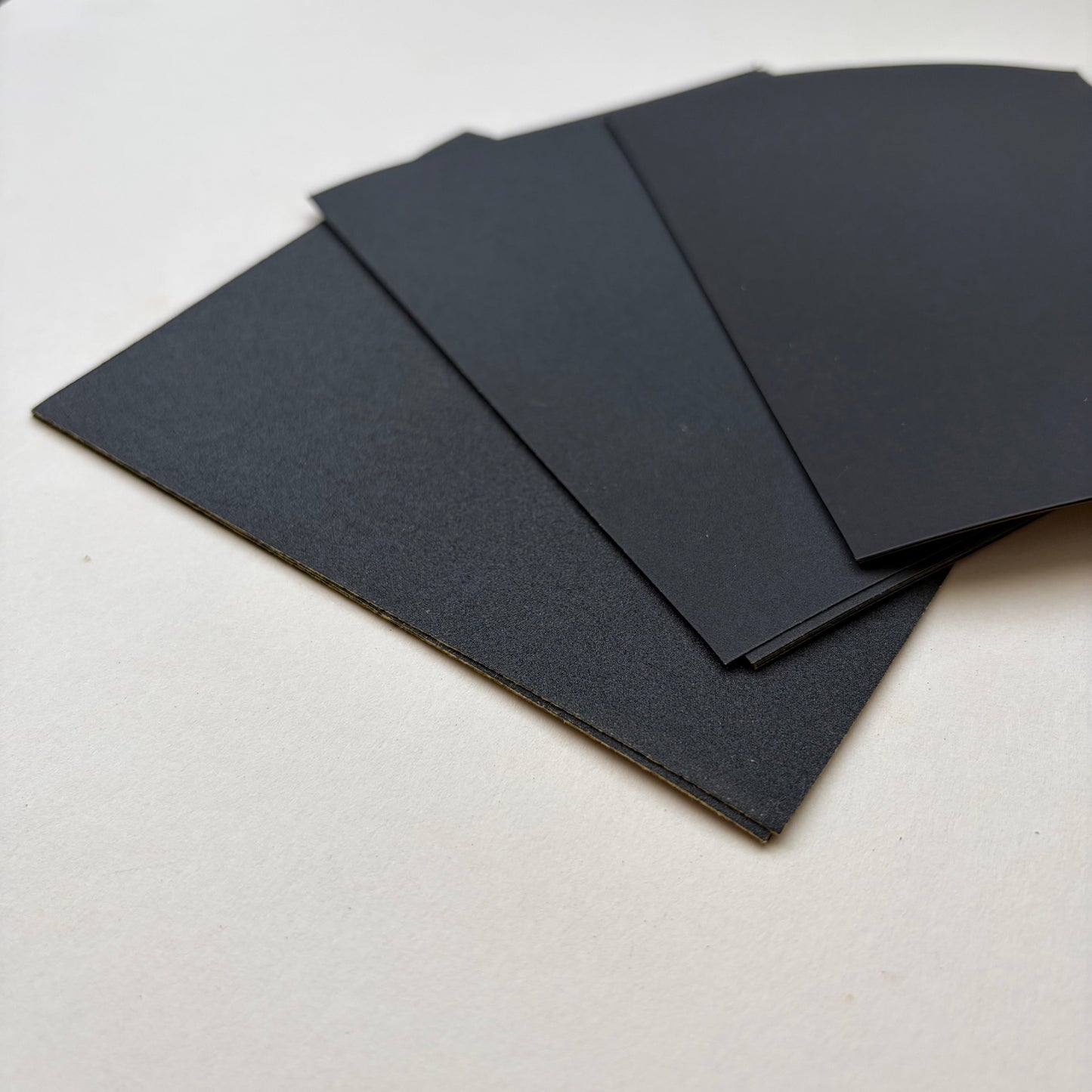
A practical 15-sheet sandpaper pack for leathercraft, containing three useful abrasive grades: 400, 800 and 1500 grit. Ideal for smoothing leather, refining edges, preparing surfaces and helping to maintain and sharpen leathercraft tools. Made of silicon carbide these sheets are also waterproof.
With five sheets of each grit, this mixed pack gives you a simple progression from coarse sanding through to fine finishing.
Each pack contains 15 small sheets of sandpaper, measuring 14 x 11 cm, in the following sizes:
- 5 × 400 grit – for initial smoothing and removing rough areas
- 5 × 800 grit – for refining surfaces after coarser sanding
- 5 × 1500 grit – for fine finishing and polishing
The compact sheets are easy to handle, making them particularly useful for detailed leathercraft work where control and precision are important.
Ideal for Leathercraft
Sandpaper is a useful addition to any leatherworker’s workshop. Use the different grits progressively to smooth rough leather edges, refine surfaces and prepare materials for a clean, professional finish.
The finer 800 and 1500 grit sheets are also useful when working with leathercraft sharpening tools, helping you refine and maintain edges as part of your sharpening routine.
For more tools and equipment for maintaining a sharp, accurate edge, explore our Leathercraft Sharpening Tools range.
Product Specifications
- 15 small sheets of sandpaper
- 3 grit grades: 400, 800 and 1500
- 5 sheets of each grit
- Ideal for leathercraft and leatherworking
- Useful for smoothing, refining and finishing
- Fine grits suitable for detailed finishing and sharpening applications
- Compact sheets (14 x 11 cm) are easy to use by hand
- A useful addition to any leathercraft tool kit or workshop
Whether you are making leather goods, finishing edges or maintaining your workshop tools, this mixed-grit sandpaper pack provides three practical grades in one convenient pack.
Contents: 15 sheets total – 5 × 400 grit, 5 × 800 grit and 5 × 1500 grit.
How to Use Sandpaper on Leather
The best grit and technique will depend on the type of leather and the job you are doing, but a simple progression is:
1. Start with 400 grit
Use 400 grit sandpaper where you need more noticeable material removal or have a rough or uneven area to smooth.
Work gradually rather than applying excessive pressure. Check your progress regularly so you remove only as much material as necessary.
2. Move to 800 grit
Once the surface or edge has been sufficiently shaped, move to 800 grit.
The purpose of this stage is to remove or reduce the scratches left by the coarser abrasive and create a more even surface.
3. Finish with 1500 grit
Use 1500 grit for the final fine-sanding stage.
This finer abrasive helps refine the surface further and can be particularly useful when preparing an edge or material for a subsequent finishing process.
Tip: Sand in a controlled, consistent direction and avoid concentrating on one small area for too long. On visible leather surfaces, always test your technique on a scrap piece first.
- Fast Shipping
- 30-Day Returns
- Workshop Tested

Why Use Sandpaper for Leathercraft?
Sandpaper is a simple but versatile addition to a leatherworker’s toolkit. It can be used to remove roughness, smooth uneven areas and gradually refine a surface rather than trying to achieve the desired finish in one step.
When working with leather, a smooth and consistent edge or surface can make a significant difference to the finished item. Sanding can help remove small imperfections and prepare an edge for subsequent finishing, burnishing or polishing.
Sandpaper can also be useful when sharpening and maintaining leathercraft tools. Progressively finer abrasives can be used to refine a tool edge and remove the marks left by a coarser abrasive.
Our Customers Say...
Why Shop with British Leather Supplies?
Fair and affordable pricing
Quality and Reliable
Fast Shipping
Friendly Support
Workshop Tested
Frequently Asked Questions
Why use different grits?
Different sandpaper grits perform different jobs.
400 grit is the coarsest grade in this pack. It is useful when you need to remove material relatively quickly or deal with a rough surface.
800 grit provides a finer abrasive for smoothing the marks left by 400 grit and refining the surface further.
1500 grit is the finest grade in the pack. It is useful for fine finishing and refining surfaces where a smoother result is required.
Using the grits progressively means you can control how much material you remove at each stage.
How do I Sand Leather Edges?
Sanding can be particularly useful when preparing leather edgesfor finishing.
After cutting and assembling your leather, an edge may have slight irregularities or fibres that need to be tidied. Sanding can help create a more uniform edge before applying your chosen edge-finishing or burnishing method.
For a typical edge-finishing process:
- Cut and assemble the leather carefully.
- Allow any adhesive to dry fully.
- Begin with 400 grit if the edge needs significant smoothing.
- Move to 800 grit to refine the edge.
- Finish with 1500 grit for a finer surface.
- Brush away sanding dust before applying edge finish, dye, gum or burnishing compound.
- Continue with your preferred leather edge-finishing process.
The key is to let the abrasive do the work. Excessive pressure can create uneven areas rather than improving the finish.
Can I Use Sandpaper for Sharpening Leathercraft Tools?
Fine abrasive paper can also form part of a leathercraft tool sharpening system.
When sharpening knives, skiving tools, blades and other edged leathercraft tools, the general principle is to start with a suitable abrasive for establishing or repairing the edge and then progressively use finer abrasives to refine it.
This pack’s 800 and 1500 grit sheets can be useful for fine sharpening and finishing stages, depending on the tool and the condition of its edge.
For the best results:
- Keep the sharpening angle consistent.
- Use controlled, even strokes.
- Avoid unnecessary pressure.
- Progress from coarser to finer abrasives.
- Remove abrasive residue between stages.
- Check the edge regularly rather than relying solely on a set number of strokes.
For dedicated sharpening equipment and accessories, see our Leathercraft Sharpening Tools range.
Which Sandpaper Grit Should I Use?
If you’re not sure which grit to start with, use the following as a general guide:
400 grit – shaping and initial smoothing
Choose 400 grit when the surface or edge is relatively rough and you need to remove material or even out imperfections.
800 grit – smoothing and refinement
Choose 800 grit after 400 grit to reduce coarse sanding marks and produce a smoother finish.
1500 grit – fine finishing
Choose 1500 grit when you want to refine the surface further or finish a sharpening process with a finer abrasive.
A simple rule to remember
400 → 800 → 1500
Start coarse, refine with a medium grit, then finish with the finest grit needed for the job.
You do not always need to use all three grades. If the surface is already reasonably smooth, you can start with 800 or 1500 grit rather than using a coarser abrasive unnecessarily.
Why Buy a Mixed-Grit Sandpaper Pack?
Having several grades of sandpaper together means you can adapt your approach to different leathercraft jobs without needing to buy each grit separately.
This compact pack is useful for:
- Leather edge preparation
- Smoothing rough leather edges
- Removing minor surface imperfections
- Refining leathercraft projects
- Preparing edges for burnishing
- Fine finishing work
- Sharpening and maintaining leathercraft tools
- General workshop and craft use
The small sheets are particularly convenient for leathercraft because they can be used by hand and are easy to fold, tear or cut to suit smaller jobs.